
Bloated and Tired After Eating? What Actually Helps
You finish a large meal, eat a few more sweets than planned, and suddenly the rest of the day feels cancelled. Your stomach is tight, your energy disappears, and the couch becomes far more persuasive than the workout, household project, or productive afternoon you had imagined. If your muscles are already sore from training, the combination can make your entire body feel slow, heavy, and uncomfortable.
This is exactly the kind of moment that attracts “biohacks.” People recommend special teas, supplements, fasting, cold showers, stretching routines, digestive enzymes, baths, belly massage, or bouncing on a mini trampoline. Some of these strategies may make you feel better, some work only in certain situations, and others are clever stories built around very little evidence.
The good news is that you usually do not need an exotic solution. A handful of simple actions can reduce discomfort, restore some energy, and help you avoid turning one oversized meal into an entire lost day. The more important question is not which hack sounds most impressive, but what kind of bloating you are actually experiencing and what caused it.
What Bloating Actually Is
Bloating is the sensation of pressure, fullness, or swelling in the abdomen. Distension is the measurable expansion of the abdomen, and the two do not always appear together. You can feel intensely bloated without looking different, while another person may notice visible expansion with surprisingly little discomfort.
Gas is one possible cause, but it is not the whole explanation. A large volume of food, constipation, swallowed air, fluid retention, sensitivity to normal digestive activity, and changes in how the abdominal muscles respond can all contribute. That is why a remedy that helps one person may do almost nothing for another.
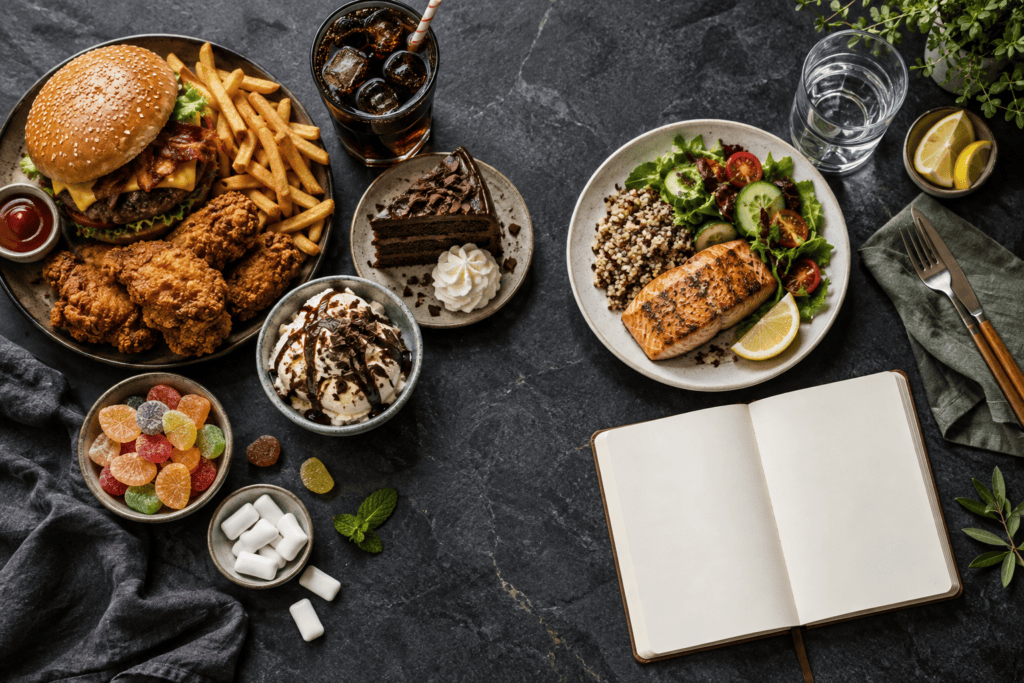
Before trying to “flush” or force anything through your body, it helps to recognize the three different experiences involved: digestive pressure, post-meal tiredness, and exercise-related muscle soreness. These images show the contrast between the uncomfortable starting point, the best-supported form of post-meal movement, and the more experimental rebounding approach.
- “Bloated and tired after eating a large meal with sweets and a fizzy drink”
- “Gentle 10-minute walk after eating to help relieve abdominal bloating”
- “Low-impact mini-trampoline rebounding as a short daily movement break”
When these sensations arrive at the same time, they can feel like one large physical crash. However, your sore legs are not causing gas, and intestinal gas is not creating delayed-onset muscle soreness. Separating the problems allows you to choose a response that makes sense instead of hoping one dramatic trick will fix everything.
Why Overeating and Sweets Can Make You Feel Miserable
An oversized meal physically stretches the stomach and gives the digestive system more material to process. Meals rich in fat can remain satisfying for longer, but they may also intensify fullness and bloating in susceptible people. If you eat quickly, talk throughout the meal, drink through a straw, chew gum, or chase dinner with a carbonated drink, you may also swallow more air.
Sweets add another layer because “sugar” is not a single digestive experience. Some candies and protein products contain sugar alcohols such as sorbitol, maltitol, mannitol, xylitol, or erythritol, which can cause gas or loose stools in some people. Dairy-based desserts may cause symptoms in someone who handles lactose poorly, while very large portions of almost anything can create discomfort simply through volume.
The popular explanation for the post-meal crash is that digestion steals blood from your brain. That story is memorable, but it is an oversimplification. Meal size, poor sleep, the natural afternoon dip in alertness, alcohol, individual glucose regulation, and the tendency to become inactive after eating can all influence how sleepy you feel.
It is also easy to confuse comfort with recovery. Lying down may feel appealing, but it can make reflux more likely and removes the gentle muscular activity that sometimes helps gas move through the digestive tract. A short rest is not a moral failure, but automatically surrendering the next three hours to the couch can reinforce the heavy, sluggish feeling you wanted to escape.
The Best Immediate “Hack”: Walk for 10 to 15 Minutes
If you are merely full and uncomfortable—not experiencing severe pain, dizziness, vomiting, or another concerning symptom—the most practical first step is a gentle walk. The goal is not to burn off the meal, punish yourself, or set a pace record. It is simply to remain upright and introduce easy movement while your body digests.
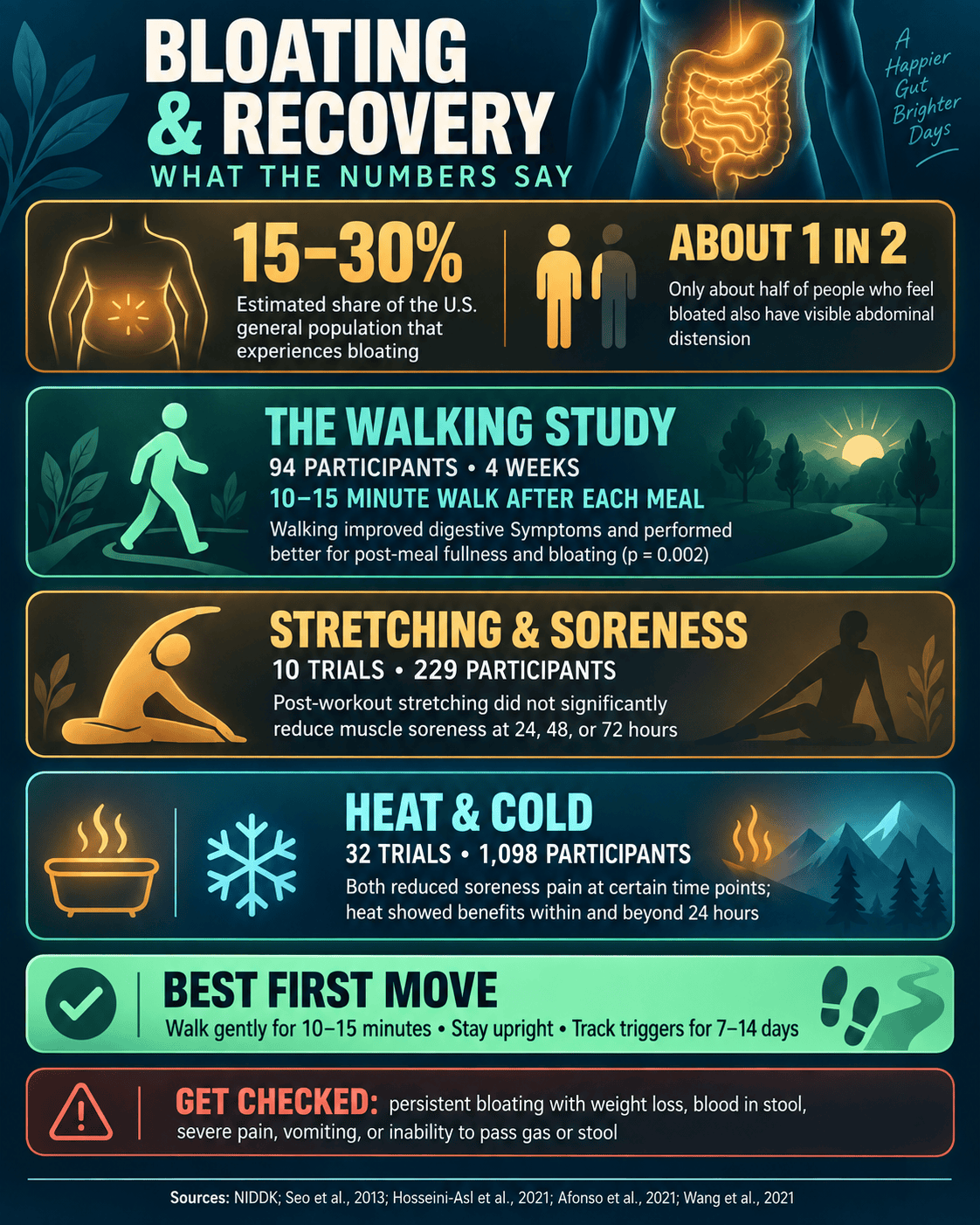
A small randomized clinical trial compared medication with a 10- to 15-minute walk after meals for four weeks. Both approaches were associated with improvement, and walking performed particularly well for post-meal fullness and bloating. The study was modest and does not prove that walking cures every cause of bloating, but it offers more relevant evidence than most viral digestive hacks. You can review the post-meal walking study on PubMed.
Keep the intensity low enough that you can breathe comfortably and hold a conversation. Hard running, repeated jumping, or a demanding abdominal workout immediately after overeating may produce nausea, reflux, cramping, or an urgent search for a bathroom. Ten calm minutes around the block, through a store, or even around the house is enough to test whether movement helps you.


A Practical 30-Minute Bloating Reset
There is no button that instantly empties the stomach, but you can stop making the situation worse and create better conditions for relief. Try this sequence after an ordinary episode of overeating or post-meal heaviness. It is deliberately simple because complicated recovery rituals are the ones people abandon.
- Stop eating and give the meal time to settle. Do not keep picking at dessert because the day already feels “ruined.” More volume usually means more work for an already uncomfortable digestive system.
- Stay upright for several minutes. Loosen a tight belt or waistband and avoid collapsing flat on the couch. Upright posture will not magically drain the stomach, but it can be more comfortable and may reduce reflux compared with lying down.
- Take a gentle 10- to 15-minute walk. Move easily rather than trying to compensate for calories. If walking increases pain, nausea, or dizziness, stop and reassess.
- Sip fluid according to thirst. Water can help you meet your normal hydration needs, but chugging a huge amount will not wash food through the digestive tract. Adding a large volume of liquid to a very full stomach may temporarily make fullness worse.
- Use warmth for comfort. A warm bath, shower, or heating pad may help tense muscles relax and can make the entire situation feel less oppressive. Keep the temperature comfortable, particularly if you are dehydrated, light-headed, or prone to feeling faint.
- Resume your day with a small task. Wash the dishes, prepare tomorrow’s clothing, or walk outside for five more minutes. The aim is to interrupt the automatic progression from discomfort to inactivity to an unplanned two-hour nap.
This reset is not meant to override illness or serious symptoms. It is for the familiar “I ate too much and now I feel gross” episode that otherwise hijacks a normal evening. If the discomfort is unusual, severe, or repeatedly happening after modest meals, investigation matters more than another home remedy.
Does Jumping on a Mini Trampoline Help Bloating?
The idea sounds believable because bouncing creates visible movement throughout the body. It is tempting to imagine each landing mechanically pushing food downward, moving gas along, stimulating lymph flow, straightening posture, and strengthening the spine all at once. That picture is satisfying—but human digestion is not a clogged pipe that needs to be shaken.
Food is moved by coordinated muscular contractions called peristalsis, not by gravity alone. That is why a person can swallow while lying down or even upside down. Gentle activity may support intestinal gas clearance and change how discomfort feels, but there is not strong evidence that 100 trampoline bounces specifically accelerate digestion or “push food down.”
That does not make a mini trampoline useless. A short rebounding session can raise your heart rate, challenge balance, activate the legs, and make movement feel playful enough that you actually do it. One hundred small, controlled bounces can function as a convenient movement snack, especially on a day when a formal workout feels unlikely.
Timing is the catch. Bouncing immediately after a large meal may be uncomfortable and could aggravate reflux or nausea, so walking is the more sensible first experiment. If the meal has settled, you feel stable, and bouncing causes no symptoms, a gentle session later can be treated as exercise—not as a digestive treatment or a way to erase overeating.
Claims about the spine also deserve restraint. Rebounding loads the legs and requires postural control, but that is not the same as proving that it strengthens the spinal bones, fixes posture, or treats back problems. Anyone with balance difficulties, pelvic-floor symptoms, joint trouble, an injury, or a condition affected by bouncing should choose an appropriate activity and seek professional guidance when necessary.
Stretching, Baths, and Sore Muscles
When bloating collides with sore muscles, it is natural to search for one recovery routine that fixes both. Gentle stretching can reduce the sensation of stiffness and help you move through a comfortable range of motion. However, research has not shown that post-workout stretching reliably prevents or substantially reduces delayed-onset muscle soreness.
That distinction matters because something can feel good without accelerating tissue recovery. Five minutes of easy mobility may help you stand taller, breathe more comfortably, and become willing to walk, which is valuable in its own right. Aggressively forcing a sore muscle into a painful stretch is unlikely to improve the situation and may irritate an injury.
A warm bath is another reasonable comfort tool. Heat can temporarily reduce soreness and muscle tension, while the quiet environment may help your nervous system settle after a demanding day. The bath is not detoxifying the meal, melting fat, or removing lactic acid, but it may make you feel noticeably better—and relief does not need a mystical explanation to be worthwhile.
Normal delayed-onset muscle soreness often develops after unfamiliar or demanding exercise and is usually most noticeable over the following day or two. Easy movement, adequate food, sufficient protein, hydration, and sleep provide a less exciting but more credible recovery foundation. Sharp pain, major swelling, weakness, joint instability, dark urine, or pain that keeps worsening should not be dismissed as ordinary soreness.
Should You Take a Painkiller?
Pain medication does not treat bloating, and it should not be the automatic answer to normal training soreness. Over-the-counter medicines carry real risks and can interact with health conditions, alcohol, prescriptions, or other products containing the same ingredient. Some anti-inflammatory medications can also irritate the stomach, which is a poor trade when your digestive system already feels unsettled.
If discomfort is significant enough that you are considering medication, follow the product label and confirm with a pharmacist or healthcare professional that it is appropriate for you. Never use pain relief to numb a possible injury so you can force another hard workout. Repeatedly needing medication after ordinary exercise is a signal to examine training volume, recovery, technique, and the possibility that the pain is not routine soreness.
Preventing the Next Bloating Crash
The most effective “bloating hack” may happen before the meal. Eating more slowly gives you time to notice increasing fullness, while smaller portions reduce the physical load arriving all at once. You can always take more food, but it is difficult to negotiate with an overloaded stomach once the meal is finished.
The National Institute of Diabetes and Digestive and Kidney Diseases notes that fizzy drinks, straws, gum, rushed eating, certain carbohydrates, sugar alcohols, dairy, sudden high fibre intake, and high-fat foods may contribute to gas or bloating in some people. That does not mean every item on the list is bad or that everyone should eliminate it. The useful question is whether one of them repeatedly predicts your symptoms; the NIDDK guide to diet and gas provides a sensible overview.
Avoid responding with an extreme elimination diet based on one uncomfortable evening. Cutting out dairy, gluten, fruit, legumes, grains, and vegetables simultaneously may leave you with a restrictive diet and no idea which change mattered. A better investigation changes one variable at a time while keeping the rest of your routine reasonably stable.
For seven to fourteen days, record the meal, approximate portion size, how quickly you ate, and any carbonated drinks, alcohol, dairy, sugar alcohols, or unusually fatty foods. Rate bloating and fatigue from zero to ten about 30, 90, and 180 minutes later, and note bowel habits, sleep, stress, and exercise. Patterns are far more informative than trying to reconstruct last Tuesday’s meal from memory.
Why You May Be Tired for Reasons Beyond the Meal
It is easy to blame the final cookie because the crash followed it, but timing alone does not prove cause. Someone who slept poorly, completed a hard workout, skipped breakfast, worked all day, and then ate an enormous dinner has several plausible reasons to feel exhausted. The meal may be the final push rather than the entire explanation.
Try comparing similar meals at different times and under different conditions. If moderate meals consistently cause overwhelming sleepiness, or fatigue appears alongside unusual thirst, frequent urination, faintness, unexplained weight change, or other persistent symptoms, discuss it with a healthcare professional. “Food coma” is a casual phrase, not a diagnosis.
The same principle applies to bloating. Occasional discomfort after obvious overeating is different from becoming distended after normal portions several times per week. Frequency, severity, accompanying symptoms, and changes from your usual baseline determine whether self-experimentation remains reasonable.
When Bloating Should Be Checked
Regular bloating is not something you have to normalize indefinitely. Keep track of it and arrange medical advice if it persists, changes suddenly, interferes with eating or daily life, or repeatedly appears without an obvious trigger. Seek prompt care when bloating occurs with concerning features such as:
- Unintentional weight loss or repeatedly feeling full after very little food
- Persistent or severe abdominal pain, fever, vomiting, or marked tenderness
- Blood in the stool, black stool, ongoing diarrhea, or ongoing constipation
- A new abdominal lump or swelling that does not settle
- Inability to pass stool or gas, especially with increasing pain or vomiting
These signs do not automatically mean something dangerous is happening, but they change the calculation. A supplement, trampoline routine, or food diary should not delay appropriate assessment. Persistent symptoms may be related to constipation, reflux, food intolerance, irritable bowel syndrome, celiac disease, medication effects, or other conditions that require a more specific approach.
Why This Matters More Than It Seems
Bloating is easy to dismiss because it is common and often temporary. Yet repeated post-meal discomfort can shape how you eat, work, train, sleep, and socialize. It can create a cycle in which overeating causes discomfort, discomfort leads to inactivity or an unintended nap, and disrupted routines make the next meal and workout harder to manage.
Breaking that cycle does not require punishing exercise. In fact, treating movement as repayment for food can make both eating and fitness more stressful. The better goal is to restore comfort, gather useful information, and make the next decision slightly easier than the last one.
Final Verdict: Useful Habits Beat Dramatic Biohacks
If you feel bloated and tired after overeating, start with the least dramatic solution: stop eating, remain upright, and walk gently for 10 to 15 minutes. Sip rather than chug water, use a warm bath or easy mobility for sore muscles, and give your digestive system time to do work that cannot be rushed. Later, record what you ate and look for recurring triggers instead of blaming every carbohydrate or buying a shelf of digestive products.
A mini trampoline can be a fun way to add movement, but the evidence does not show that bouncing pushes food downward, cures bloating, detoxifies the body, or directly strengthens the spine. One hundred controlled bounces may still be a worthwhile daily habit if they feel comfortable and fit your physical abilities. Use rebounding because it gets you moving—not because an impressive biological story has been attached to it.
The best “biohack” is often a small action you can repeat: a slower meal, a slightly smaller portion, a short walk, a warm recovery routine, and an honest symptom log. If those basics help, you have found something practical. If they do not, that is useful information too—and a reason to investigate the cause rather than escalating the gimmicks.