
How Do Supplements Actually Work? The Science Behind Creatine, Protein, Magnesium, Omega-3s, Greens Powders & Turmeric
You scoop a few grams of white powder into a glass, drink it every day, and a couple of weeks later your muscles look noticeably fuller. You shake some whey protein into water after lifting because you have been told it helps rebuild muscle. Then there are magnesium capsules, fish oil, greens powders and turmeric—all supposedly doing something useful somewhere inside an incredibly complicated human body.
But what actually happens after you swallow them?
That question is much more interesting than another list of the “10 best supplements for men.” Supplements are often marketed as though they possess vague superpowers: boosting energy, supporting recovery, fighting inflammation, improving cellular health or optimizing performance. Those phrases sound impressive, but they do not explain what a supplement is physically doing once it passes your lips.
Creatine is perhaps the best place to start because its effects can be unusually noticeable. People who begin taking it often gain a little weight, their muscles may appear fuller, and over time they may notice improvements in strength or training performance. Compared with the mountain of supplements whose effects are difficult to distinguish from normal day-to-day variation, creatine can almost feel suspiciously effective.
The explanation, however, is not magic. It is biochemistry.
And once you understand what creatine, protein, magnesium, omega-3s, greens powders and turmeric are actually doing inside the body, the supplement aisle starts looking very different.
What Does It Mean for a Supplement to “Work”?
A supplement cannot simply arrive in your stomach and instruct your body to become healthier. Before it can accomplish anything, its ingredients have to be digested when necessary, absorbed through the digestive tract, transported through the bloodstream and eventually used by cells or incorporated into tissues.
Different substances then perform completely different jobs. Some provide raw materials the body needs to construct something. Others become components of cells themselves, while certain vitamins and minerals help enzymes carry out chemical reactions that would otherwise happen inefficiently or not at all.
This is one reason asking whether “supplements work” is almost too broad a question. It would be like asking whether tools work. A hammer, screwdriver and chainsaw all work, but they accomplish completely different things and only when you have a reason to use them.
Supplements also operate on very different timelines. Caffeine can affect your nervous system within an hour. Creatine gradually raises creatine stores inside skeletal muscle. Omega-3 fatty acids can become incorporated into cell membranes over time. Correcting an actual nutrient deficiency may eventually make someone feel much better, while taking extra amounts of something they already consume adequately may produce almost no noticeable effect.
The important question therefore becomes: What is this particular substance doing, and does my body actually need more of it?
Creatine: The Supplement That Almost Feels Like Cheating
Creatine has developed an unusual reputation in fitness because it occupies that rare intersection between relatively low cost, extensive research and measurable results. It is also not some completely foreign laboratory chemical. Your body naturally produces creatine, and you obtain additional creatine from foods—particularly meat and fish.
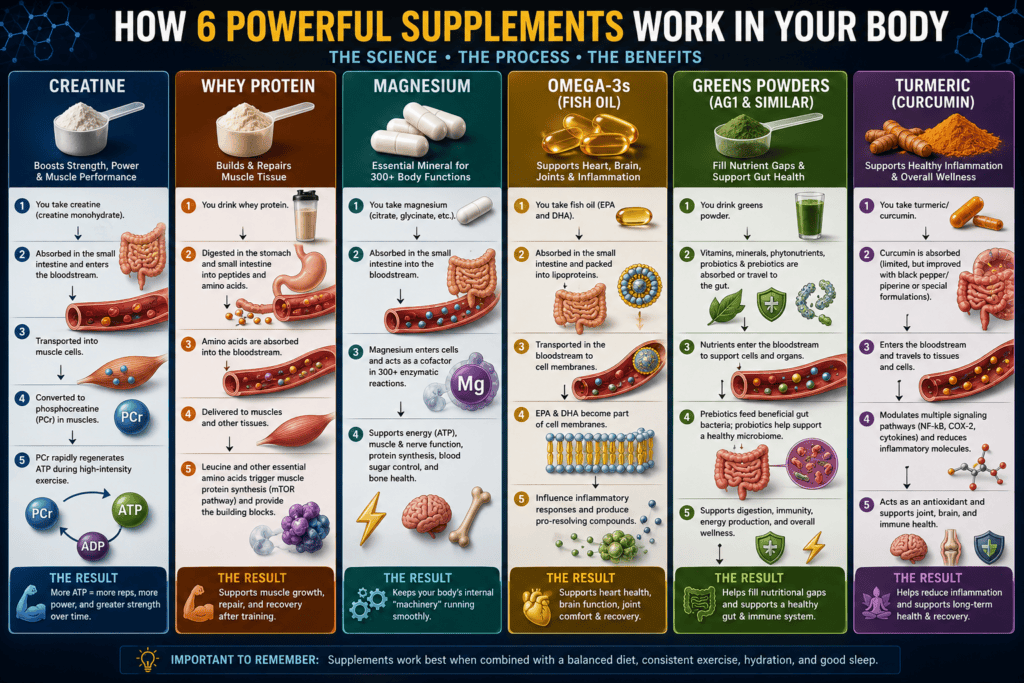
Most of the creatine stored in your body is found in skeletal muscle, where a significant portion exists as phosphocreatine. To understand why that matters, we need to talk about one of the most important molecules in your entire body: ATP.
ATP, or adenosine triphosphate, is often described as the energy currency of cells. Every time your muscles contract during a heavy bench press, sprint, squat or explosive movement, ATP is being used to provide energy. The problem is that muscle cells only store a limited amount of immediately available ATP.
That is where phosphocreatine comes in.
When ATP releases energy, it becomes ADP. Phosphocreatine can donate a phosphate group to ADP, rapidly turning it back into ATP. In simple terms, your creatine system acts like a fast rechargeable battery for intense muscular activity.
Supplementing with creatine increases the amount of creatine and phosphocreatine stored inside muscle. That does not suddenly double your strength, but it may allow your muscles to regenerate ATP slightly more effectively during repeated high-intensity efforts.
That small difference can become surprisingly valuable.
Imagine you normally perform eight hard repetitions on an exercise. Creatine might eventually help you squeeze out a ninth rep or maintain slightly more power during later sets. One extra repetition does not transform your physique, but repeat that process across exercises, workouts, months and years and you may accumulate substantially more productive training.
That is one of the major reasons creatine can contribute to increases in strength and lean mass over time.
Why Does Creatine Make Your Muscles Look Bigger?
One of the first things many people notice after beginning creatine is that their muscles look fuller. Sometimes the change happens quickly enough that it obviously cannot be several pounds of newly constructed muscle tissue.
A significant part of the explanation is water.
Increasing creatine storage inside muscle also increases water retention within muscle cells. This is largely intracellular water—water held inside the muscle tissue itself rather than simply sitting underneath the skin.
That distinction matters because people occasionally dismiss creatine-related weight gain by saying, “It is only water weight.” Technically, some of the initial increase is water, but that does not mean it is necessarily undesirable. A hydrated muscle cell is not the same thing as looking bloated from generalized fluid retention.
Creatine therefore produces two different effects that can easily be confused. There can be a relatively fast increase in muscle fullness associated with increased water inside the muscle, followed by slower improvements in actual training adaptations as better performance allows someone to accumulate more quality work.
Creatine does not directly manufacture muscle while you sit on the couch. It makes the energy system involved in intense training slightly more capable, and training does the rest.
That is far less magical than supplement advertising.
It is also far more impressive.
Does Creatine Need a Loading Phase?
The traditional creatine loading approach involves taking approximately 20 grams per day, usually split into several smaller doses, for roughly five to seven days. After that, people typically transition to a maintenance intake of around 3–5 grams per day.
Loading works because it saturates muscle creatine stores more quickly.
It is not mandatory.
Taking roughly 3–5 grams of creatine monohydrate every day will generally accomplish the same basic goal more gradually. Instead of reaching high muscle creatine stores within about a week, it may take several weeks.
For most recreational lifters, consistency matters much more than aggressively optimizing the loading process. Creatine monohydrate is also the version with the strongest research history, despite companies repeatedly inventing more exotic versions to make an inexpensive ingredient easier to sell at premium prices.
Whey Protein: Your Body Takes It Apart Before Building You Back Up
Whey protein has almost the opposite reputation of creatine. People understand that protein helps build muscle, but the explanation often stops there.
So how can something that originally came from milk eventually become part of your biceps?
When you drink whey protein, your body does not transport intact scoops of whey into your muscles. Your digestive system breaks those proteins into smaller peptides and amino acids. Those amino acids are absorbed primarily through the small intestine and enter circulation, where they become available for use throughout the body.
Amino acids are essentially raw materials.
Your body uses them to construct thousands of different proteins involved in muscles, enzymes, hormones, structural tissues and countless other biological processes. Muscle tissue is constantly undergoing turnover, meaning old proteins are being broken down while new proteins are being synthesized.
Resistance training alters that process.
When you challenge a muscle with sufficiently demanding resistance, you create a stimulus that tells the body the existing tissue needs to adapt. Muscle protein synthesis increases as part of the rebuilding and adaptation process. Supplying adequate dietary protein gives your body the amino acids necessary to perform that construction.
Whey happens to be particularly useful because it contains all nine essential amino acids and is rich in leucine. Leucine plays an important role in signaling pathways associated with muscle protein synthesis, including a pathway involving mTOR.
A useful way to picture it is this: training places the construction order, leucine helps signal that construction should begin, and amino acids provide the lumber.
You still need all three parts of the equation.
Is Whey Protein Better Than Food?
Whey is convenient, but it is not magic.
Your body can obtain high-quality protein from meat, fish, eggs, yogurt, dairy products, soy and numerous other foods. If somebody already consumes enough protein through their normal diet, adding several unnecessary protein shakes will not cause muscle to grow indefinitely.
There appears to be a point of diminishing returns.
For people engaged in resistance training, consuming enough total daily protein is considerably more important than obsessing over whether the protein came from whey or a chicken breast. Whey simply makes reaching that target extremely easy because you can consume 20–30 grams of protein in a drink without preparing another meal.
That makes protein powder one of the most practical supplements available, even if scientifically it is closer to concentrated food than a traditional performance-enhancing compound.
Magnesium: The Mineral Quietly Keeping the Machinery Running
Magnesium is not nearly as exciting in the mirror.
You usually will not wake up after taking magnesium and discover that your shoulders suddenly look larger. Yet magnesium is involved in hundreds of enzymatic reactions throughout the human body, including processes related to energy production, muscle and nerve function, protein synthesis, blood glucose regulation and bone health.
Think of magnesium as part of the machinery rather than the fuel.
Enzymes make biochemical reactions happen efficiently, and many of those enzymes depend on magnesium. Even ATP—the energy molecule we discussed in the creatine section—is commonly used by the body while bound to magnesium.
That means magnesium is deeply connected with cellular energy despite not behaving anything like creatine.
It also illustrates an important problem with supplement marketing. If magnesium is essential, marketers can easily transform “essential nutrient” into “more magnesium equals better performance.”
That does not necessarily follow.
If someone is deficient or chronically consuming too little magnesium, increasing intake can obviously be important. If magnesium intake is already sufficient, taking larger and larger doses does not give your enzymes superhero powers.
More is not automatically better.
Magnesium supplements can also cause gastrointestinal effects, especially at higher doses, with diarrhea being one of the most common complaints.
Omega-3 Fish Oil: The Supplement That Can Become Part of Your Cells
Fish oil works in an entirely different way again.
The omega-3 fatty acids most commonly associated with fish oil are EPA and DHA. Unlike some supplements that temporarily interact with receptors or enzymes before being metabolized, omega-3 fatty acids can actually become incorporated into phospholipids within cell membranes.
In other words, some of the fat you eat literally becomes part of the structure surrounding your cells.
DHA is particularly concentrated in tissues such as the brain and retina. EPA and DHA are also involved in the production of various signaling compounds and participate in processes related to inflammation, cardiovascular function and immune biology.
That sounds dramatic, but there is an important catch.
You probably cannot feel it happening.
Someone may take fish oil for weeks or months without experiencing an obvious sensation comparable with caffeine or the visual fullness sometimes associated with creatine. That does not mean absolutely nothing is happening; it simply means subjective feelings are a terrible measuring device for many nutritional processes.
Fish oil also raises another useful question: should everyone supplement with something simply because the nutrient itself is beneficial?
Not necessarily.
People who regularly consume fatty fish may already obtain meaningful quantities of EPA and DHA from their diet. Someone who rarely eats seafood may have a different nutritional situation. Algae-derived EPA and DHA products also exist for people who do not consume fish.
The goal should be adequate nutrition, not collecting the largest possible cabinet of bottles.
Greens Powders and AG1: What Exactly Is Doing the Work?
Greens powders become much more complicated because there is no single substance called “greens.”
Products such as AG1 combine numerous ingredients into one scoop. Depending on the formulation, that can include vitamins, minerals, plant powders, botanical extracts, probiotic organisms and ingredients intended to act as prebiotics.
Asking how a greens powder works is therefore somewhat like asking how breakfast works.
The answer depends on what is in it.
A vitamin may participate in enzyme reactions. A mineral may act as a cofactor or structural component. Certain fibers can reach the large intestine and become food for microorganisms living in the gut. Probiotic strains may temporarily interact with the gastrointestinal ecosystem. Plant compounds can have entirely different biological properties.
That complexity is simultaneously the appeal and the weakness of greens powders.
From the consumer’s perspective, one scoop feels like an easy nutritional insurance policy. Instead of keeping track of numerous foods and nutrients, you drink something green and feel as though you have covered your bases.
Scientifically, however, the enormous ingredient list makes it much harder to know exactly what produced a particular result.
Why Do Some People Feel Great After Taking Greens Powders?
This is where personal experience becomes interesting but difficult to interpret.
Some people genuinely report feeling more energetic or generally healthier on days when they consume a greens drink. That experience should not automatically be dismissed as imaginary. The problem is that the feeling alone cannot tell us what caused it.
Perhaps the person was previously consuming too little of a particular nutrient. Perhaps the drink increased their morning fluid intake. Maybe one botanical ingredient has a noticeable effect. The prebiotic ingredients could influence digestion, or taking the drink might simply become part of a healthier routine that includes better eating and exercise.
Expectation can play a role as well.
The placebo effect is sometimes misunderstood as meaning that somebody is “making it up.” That is not what placebo effects are. Expectations can produce measurable changes in subjective experiences such as energy, discomfort and mood.
Greens powders therefore occupy a much greyer scientific category than creatine.
That does not mean they are useless. A greens powder can provide actual nutrients. It simply means that proving the benefits of a complicated mixture containing dozens of ingredients is considerably harder than studying five grams of one specific compound.
And no greens powder should be treated as permission to stop eating fruits and vegetables.
Whole foods contain fiber, water, minerals, vitamins and thousands of plant compounds arranged in combinations that supplement manufacturers are still trying to imitate.
Turmeric and Curcumin: The “Anti-Inflammatory” Supplement Everyone Has Heard About
Turmeric is another supplement where the marketing tends to sprint ahead of the science.
Turmeric contains a family of compounds called curcuminoids, with curcumin being the most famous. Laboratory and human research has investigated curcumin’s interactions with pathways involving inflammation, oxidative stress and cell signaling.
This is where phrases such as “powerful antioxidant” usually enter the conversation.
The problem is that biological chemistry is considerably more complicated than imagining curcumin molecules racing around your bloodstream and personally destroying harmful free radicals.
One major issue is bioavailability.
Standard curcumin is poorly absorbed, which means swallowing a large amount does not necessarily produce a correspondingly large concentration in the bloodstream. Manufacturers have attempted to overcome this with different formulations and compounds such as piperine from black pepper that can increase absorption.
But improving absorption creates another lesson that applies across supplementation: increasing the amount of a biologically active compound reaching your bloodstream does not automatically make something safer or universally healthier.
Curcumin has produced interesting results in areas such as joint discomfort and osteoarthritis research, but the total body of evidence is not nearly as definitive as creatine research for resistance training.
It deserves investigation.
It does not deserve mythology.
The Antioxidant Myth Is More Complicated Than It Sounds
The word “antioxidant” has become almost synonymous with “healthy,” but human physiology does not work according to such a simple equation.
Reactive oxygen species can damage cells when produced excessively, but they also participate in normal cellular signaling. Exercise itself temporarily increases oxidative stress, and some of that stress contributes to the signals that tell the body to adapt to training.
That means completely eliminating oxidation would not necessarily be desirable even if it were possible.
Your body already possesses sophisticated antioxidant systems involving compounds and enzymes such as glutathione, catalase and superoxide dismutase. Dietary compounds can interact with this broader system, but the idea that swallowing an antioxidant pill simply scrubs toxins from the body is a cartoon version of reality.
This is especially important when evaluating supplements marketed around words such as “detox,” “cleanse” and “cellular purification.”
Those phrases should immediately trigger your skeptical instincts.
If You Feel a Supplement Working, Does That Mean It Works?
Not necessarily.
This is one of the strangest lessons in supplementation: the intensity of the feeling does not necessarily tell you the importance of the effect.
Caffeine makes itself obvious because it affects receptors in the nervous system. Creatine may eventually produce noticeable changes in muscle fullness and exercise performance. Fish oil can alter tissue fatty-acid composition without producing any sensation whatsoever.
Magnesium can be essential for hundreds of biochemical reactions while feeling spectacularly boring.
On the other hand, a supplement can make someone feel something without producing the long-term outcome they purchased it for. Stimulants are a perfect example. Feeling energized does not automatically mean you are healthier, recovering better or building more muscle.
This is why researchers rely on measurable outcomes rather than testimonials.
If somebody says, “I started taking this supplement and felt incredible,” that is interesting information. It just is not proof.
Sleep, hydration, diet, training, stress, expectations and normal biological variation can all change simultaneously.
Why Creatine Stands Out From the Supplement Crowd
The reason creatine keeps coming up in serious sports-nutrition discussions is not because its marketing is better.
It is because the evidence is unusually consistent.
We understand where creatine is stored. We understand the phosphocreatine energy system. Researchers can measure changes in muscle creatine concentrations. We can measure strength, training volume, lean mass and performance outcomes across controlled studies.
The biological mechanism and the real-world results line up remarkably well.
That is the standard every supplement should ideally meet.
Compare that with a bottle containing 38 plant extracts where the manufacturer promises “whole-body cellular optimization.” Which ingredient causes the effect? What concentration reaches the bloodstream? What biological pathway changes? How large is the benefit? Has an independent research team reproduced it?
Suddenly the flashy label looks less convincing.
Supplements Are Usually the Small Part of the Fitness Equation
This is the part supplement companies would rather keep in the fine print.
A well-designed supplement may improve something by a few percentage points. Your fundamental habits determine nearly everything else.
Creatine cannot rescue a training program you rarely follow. Protein powder cannot compensate for eating poorly throughout the rest of the day. Magnesium cannot replace adequate sleep. Fish oil cannot neutralize smoking, chronic inactivity or a consistently terrible diet.
Greens powder does not erase five servings of fast food.
Turmeric does not cancel years of sedentary behavior.
That does not make supplements worthless. Small advantages matter, especially when someone already has the big pieces in place. A three-percent improvement compounded across hundreds of workouts can become meaningful.
The mistake is spending 90 percent of your attention chasing the final 5 percent while ignoring the foundational 95 percent.
A Sensible Way to Think About These Supplements
If we strip away the branding and look only at what each product is trying to accomplish, the differences become clearer.
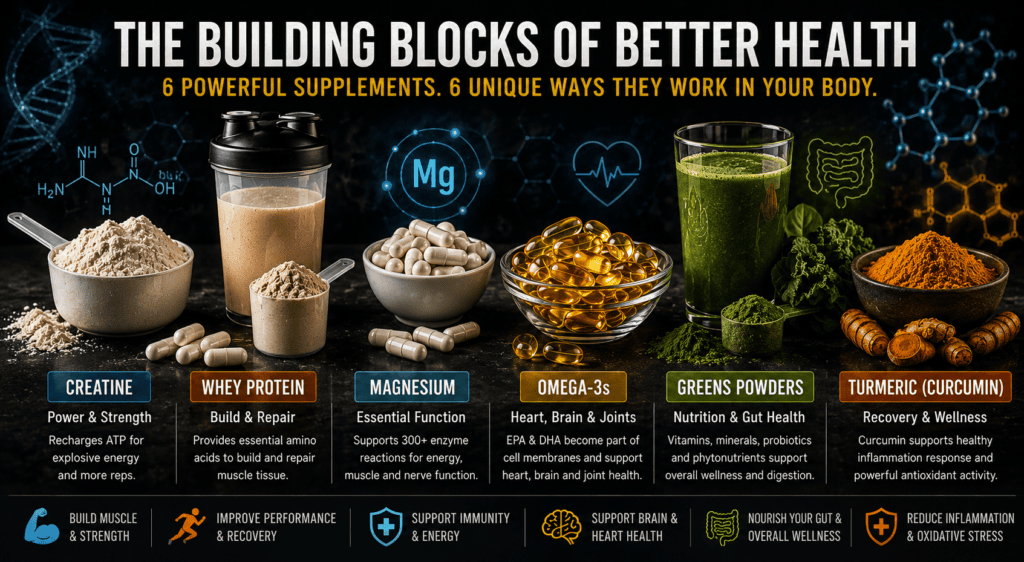
- Creatine monohydrate: increases muscle creatine stores and supports rapid ATP regeneration during intense activity. It has one of the strongest evidence bases among sports supplements.
- Whey protein: provides essential amino acids and makes reaching an appropriate daily protein intake easier. Useful, but fundamentally a convenient food product.
- Magnesium: an essential mineral involved in hundreds of biochemical reactions. Supplementation is most compelling when intake is inadequate rather than as an unlimited performance enhancer.
- Omega-3s: EPA and DHA can become incorporated into cell membranes and participate in numerous physiological processes. Whether supplementation makes sense depends partly on dietary intake and individual circumstances.
- Greens powders: convenient mixtures of nutrients and plant compounds that may help fill dietary gaps, but their complexity makes sweeping claims harder to prove.
- Turmeric and curcumin: biologically interesting compounds with promising research in certain areas, but far more nuanced evidence than the phrase “powerful anti-inflammatory” suggests.
Notice how none of these descriptions requires magic.
That is a good sign.
Why Understanding Supplements Matters More Than Ever
Modern supplement marketing has become incredibly sophisticated.
Labels now use language borrowed from molecular biology: mitochondrial support, cellular energy, metabolic pathways, microbiome optimization, neuroprotection and inflammatory signaling. Those concepts are real, which makes them particularly useful for selling products.
The trick is that a real scientific concept can still be attached to an exaggerated conclusion.
A nutrient participating in energy metabolism does not necessarily mean taking more of it increases your energy. A compound demonstrating antioxidant activity in a laboratory does not prove swallowing it extends your life. An ingredient affecting cancer cells in a Petri dish does not mean it treats cancer in human beings.
A useful habit is to ask five questions whenever you encounter an impressive supplement claim:
- What is the actual active ingredient?
- Can the body absorb a meaningful amount of it?
- What biological mechanism is being proposed?
- Have controlled human studies shown a useful outcome?
- Is the size of that benefit meaningful enough to matter?
Those questions eliminate an enormous amount of nonsense.
They also make genuinely effective supplements more impressive.
The Supplement Cabinet Should Have a Purpose
There is another trap worth avoiding: collecting supplements simply because each one has some potential health benefit.
Eventually you can end up taking ten powders and fifteen capsules every morning without being able to explain why any particular one is there.
A better approach is to give every supplement a job.
Creatine might be there because you resistance train and want to support strength and high-intensity performance. Whey might exist because reaching your protein target through food alone is inconvenient. Omega-3 might be used because you rarely eat fatty fish.
That is very different from taking something because an advertisement said it “supports wellness.”
If you cannot explain what a supplement is supposed to accomplish, why you personally need it and whether there is reasonable evidence behind that purpose, it may not deserve a permanent spot in your cabinet.
Final Verdict: Some Supplements Really Are Excellent
Supplements are neither miracles nor scams as a category.
They are molecules.
And molecules have to obey biology.
Creatine deserves much of its reputation because the pathway from supplementation to physiological effect is remarkably clear. You increase muscle creatine stores, improve your capacity to regenerate ATP during high-intensity activity, potentially perform slightly more productive training and, over time, improve strength and muscle-building outcomes. The early muscle fullness many people notice is partly related to increased water inside muscle cells, while longer-term benefits come from training adaptations.
Whey protein is simpler but equally logical. Your body digests protein into amino acids, absorbs those amino acids and uses them as raw materials for countless biological structures—including skeletal muscle. Resistance training provides the stimulus, adequate protein provides the materials, and recovery gives your body the opportunity to rebuild.
Magnesium illustrates how vital nutrients can perform enormously important jobs without creating dramatic sensations. Omega-3 fatty acids show that nutrients can literally become structural components of cells. Greens powders demonstrate both the potential convenience and scientific difficulty of combining dozens of ingredients into one product. Turmeric reminds us that fascinating mechanisms do not automatically translate into miraculous human outcomes.
The real lesson is bigger than any individual supplement.
Stop asking only, “Does this supplement work?”
Ask:
“What does it actually do inside my body?”
That question forces marketing claims to confront biology.
And once you start thinking that way, it becomes much easier to separate useful tools from expensive powder.
For evidence-based information on supplements and nutrient intake, the NIH Office of Dietary Supplements provides detailed fact sheets covering many common vitamins, minerals and dietary supplements. For research-based sports nutrition information, the International Society of Sports Nutrition publishes position stands and reviews on subjects including creatine and protein.
This article is for general educational purposes and is not a substitute for individualized medical advice. Supplements can interact with medications and may not be appropriate for everyone, particularly at high doses or in people with certain health conditions.