
What Happens When You Walk 30,000 to 40,000 Steps a Day?
Most people have heard that 10,000 steps a day is a healthy goal. But what happens when 10,000 becomes the warm-up? Imagine adopting a routine where your fitness tracker regularly finishes the day at 30,000, 35,000 or even 40,000 steps—and doing that five days every week. At that point, walking is no longer simply a healthy habit squeezed into your day. It has become a serious physical workload.
After only a short period of that lifestyle, you may begin noticing some surprisingly dramatic changes. Your appetite can climb, your feet and calves may become remarkably resistant to fatigue, distances that initially seemed enormous begin to feel normal, and body weight may become harder to maintain unless you deliberately eat more. At the same time, the end of a 30,000-step day can leave you feeling thoroughly exhausted even though you never technically went for a “workout.”
There is something strangely natural about spending hours walking. Humans evolved in environments where movement was unavoidable, long before cars, desk jobs, elevators and food delivery allowed us to eliminate most of it. But does that mean humans are actually supposed to walk 30,000 or 40,000 steps every day? And if walking is so healthy, would 50,000 steps be even better?
The answer is fascinating because extremely high-volume walking sits somewhere between ordinary daily activity and endurance training. The benefits can be substantial, but more is not infinitely better.
How Far Is 30,000 to 40,000 Steps?
Step counts can make enormous distances sound deceptively simple. Depending on stride length, 30,000 steps can easily represent more than 20 kilometres of walking, while 40,000 can push toward 30 kilometres. At 50,000 steps, some people may travel roughly 35 to 40 kilometres—approaching marathon distance on foot.
Spread across an entire workday or active day, that may not feel as dramatic as intentionally walking a marathon. You stop, turn around, climb stairs, cross streets, stand still and perform other activities along the way. Your tissues do not care what you call it, however. Your feet, calves, hips, bones and connective tissues still have to absorb tens of thousands of loading cycles.
The intensity of an individual step may be relatively low, but volume changes everything. According to the Compendium of Physical Activities, moderate walking on firm level ground is roughly a 3.8-MET activity, while brisk walking can reach around 4.8 METs. Perform that activity for several hours and the accumulated energy demand becomes substantial.
That is one reason people who suddenly begin walking huge distances may feel as though their appetite has been switched into another gear.
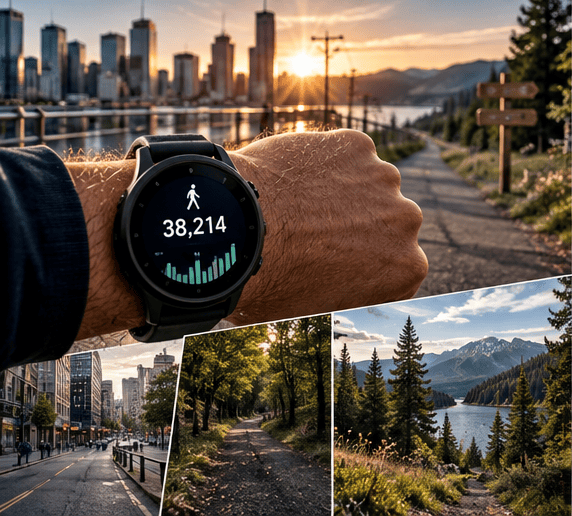
Humans Are Remarkably Good at Walking
There is some truth behind the popular idea that humans are endurance animals. Our upright gait, long legs, ability to regulate body temperature and relatively economical bipedal locomotion allow us to cover considerable distances without needing extraordinary speed. For much of human existence, travelling, gathering resources, hunting and moving between locations required far more physical movement than most modern lifestyles demand.
Research involving the Hadza hunter-gatherers of Tanzania gives us an interesting real-world comparison. One GPS-based study found adult Hadza women travelled about 7.6 kilometres and roughly 10,888 steps per day, while men travelled around 12.9 kilometres and logged about 18,476 steps. At some ages, men averaged around 15 kilometres of daily travel.
Those are impressive numbers compared with many sedentary modern populations, but they also undermine an exaggerated version of the ancestral argument. Hunter-gatherer data do not show that humans must walk 40,000 steps every day to live naturally. In fact, 30,000 to 50,000 daily steps can substantially exceed the average movement recorded in highly active traditional populations.
The more defensible conclusion is that human beings are extremely well equipped for frequent movement and sustained walking. We evolved in circumstances where sitting almost motionless for most waking hours would have been unusual. That is very different from claiming there is some prehistoric 40,000-step target encoded into our biology.
Your Energy Needs Can Change Dramatically
One of the first things someone may notice after jumping from perhaps 8,000 or 10,000 daily steps to 30,000 or more is hunger. Food intake that once maintained body weight may suddenly feel inadequate. This should not be particularly mysterious: physically moving your entire body through tens of kilometres requires energy.
The exact calorie cost is impossible to determine from step count alone. Body weight, speed, hills, terrain, temperature, carrying loads and walking economy all matter. Even so, several hours of additional walking can increase daily energy expenditure by many hundreds of calories, and under demanding conditions the difference can become considerably larger.
That can produce unexpected weight loss if food intake remains unchanged. Someone who begins a massively more active routine and continues eating exactly as before may unintentionally create a substantial energy deficit. Rapid changes on the scale should not automatically be interpreted as pure fat loss, however, because glycogen, water balance and the amount of food in the digestive system can all shift when activity levels change.
If body weight keeps dropping despite trying to maintain it—or the weight loss is unusually rapid, unexplained or accompanied by weakness or other symptoms—it is worth treating that as more than a fitness achievement. Extremely high activity creates a plausible explanation for increased calorie needs, but it should not become an excuse to ignore persistent unintended weight loss.
Your Feet, Calves and Legs Begin Adapting
Walking 30,000 steps once is an event. Walking 30,000 to 40,000 steps repeatedly is training.
Every step requires coordinated work from the muscles of the feet, calves, quadriceps, hamstrings, glutes and hips. None of those individual contractions is particularly impressive compared with a heavy squat, but repeated tens of thousands of times they create a powerful endurance stimulus. The result is that routes that initially leave the legs feeling destroyed can eventually become surprisingly manageable.
The feet are particularly interesting because they contain a complicated network of muscles, tendons, ligaments and bones that must repeatedly stabilize the body. The calf muscles also spend the day helping propel you forward, while the glutes and hip stabilizers control the pelvis as you repeatedly transfer your weight from one leg to the other. Even the trunk participates by stabilizing the torso and managing the rotational forces created during gait.
Someone doing this much walking may legitimately feel that their feet, calves and legs are becoming stronger. More precisely, however, they are becoming much better conditioned for repeated submaximal movement. That distinction matters because muscular endurance is not the same thing as maximum strength or muscle growth.
You can become exceptionally good at walking without developing legs like a powerlifter.
What Happens to Your Heart and Metabolic Health?
The cardiovascular benefit is where high-volume walking becomes particularly interesting. Walking usually produces a lower heart rate than running, but accumulating several hours of movement means the cardiovascular system spends a very large portion of the day supporting active muscle rather than sitting at near-resting demand.
That is legitimate physical activity. The World Health Organization recommends that adults accumulate at least 150 to 300 minutes of moderate aerobic activity each week and specifically recognizes occupational activity, transportation and everyday movement as part of total physical activity. WHO also recommends muscle-strengthening work involving all major muscle groups on at least two days per week.
A person regularly walking 30,000 to 40,000 steps can blow past the minimum aerobic recommendation without ever stepping onto a treadmill. Regular walking also repeatedly increases muscular glucose uptake and reduces the amount of the day spent completely sedentary. The overall pattern is radically different from sitting for ten hours and then performing one 30-minute workout.
The broader step-count research is impressive. A 2025 systematic review and dose-response meta-analysis covering 57 studies from 35 cohorts found that, compared with 2,000 daily steps, roughly 7,000 steps per day was associated with substantially lower risks across several health outcomes. That included a 47% lower risk of all-cause mortality, 25% lower cardiovascular disease incidence and 22% lower risk of depressive symptoms, although these are associations from prospective studies rather than proof that steps alone caused every difference.
But 40,000 Steps Is Not Four Times Better Than 10,000
This may be the most important point in the entire discussion.
Fitness trackers encourage us to think about movement as a score. Seven thousand is good, 10,000 is better, 20,000 is excellent—so surely 40,000 must be phenomenal. Biology rarely works that neatly.
The 2025 analysis found that several outcomes showed clear diminishing returns, with important inflection points around 5,000 to 7,000 daily steps. Other research has likewise found that mortality benefits tend to level substantially once people reach moderate-to-high step counts rather than continuing to improve proportionally forever.
This does not mean everything above 7,000 steps is wasted. Additional movement still burns energy, develops endurance, reduces sedentary time and may serve occupational, recreational or athletic goals. What the evidence does not support is the idea that somebody walking 40,000 steps is automatically four times healthier than somebody walking 10,000.
The biggest health transformation may occur when a largely sedentary person becomes moderately active. Once someone is already very active, pushing the number higher becomes increasingly about fitness, energy expenditure, endurance and lifestyle rather than unlocking some secret longevity multiplier.
Walking Huge Distances Versus Running
Walking has one enormous advantage when it comes to accumulating volume: each stride is generally easier to recover from than a running stride.
Running introduces an airborne phase followed by repeated landings, and the mechanical forces generated during running are generally higher than during ordinary walking. That is one reason many people could gradually adapt to walking 20 kilometres without being remotely prepared to run 20 kilometres. The cardiovascular demand, muscle damage and recovery requirements are simply different.
That does not mean running destroys your joints. The idea that recreational running inevitably causes knee arthritis is not well supported by the evidence. A systematic review and meta-analysis involving more than 100,000 people actually found a lower prevalence of hip and knee osteoarthritis among recreational runners than among sedentary controls, although competitive high-volume runners showed a different pattern and observational research cannot prove simple cause and effect.
So the sensible comparison is not “walking is safe and running is dangerous.” Walking simply allows most people to accumulate far more total movement with less mechanical stress per stride. That makes extremely high daily volumes more achievable.

Does Walking Replace the Gym?
This is where walking enthusiasts sometimes go too far.
Thirty or forty thousand steps is an enormous amount of physical activity, but it is not a complete strength-training program. Your legs are performing thousands of repetitions, your hips are stabilizing your body and your core is helping control your torso, but those muscles are working against relatively modest resistance.
Your arms illustrate the problem perfectly. Arm swing is useful for efficient gait, but swinging an unloaded arm thousands of times is not comparable with curls, rows, pull-ups or presses. Walking 40,000 steps will not provide your biceps with the progressive resistance required for substantial muscle growth.
The same principle applies to your legs. High-volume walking can build tremendous local endurance while leaving plenty of room for improvement in maximum strength, power and muscle mass. Someone who wants a balanced, capable physique should therefore think of walking and resistance training as complementary rather than competing activities.
For a person already doing enormous walking volume, a sensible gym routine might emphasize:
- Upper-body pulling through rows, pull-ups or pulldowns.
- Upper-body pushing through presses, push-ups or bench variations.
- Direct biceps and triceps work if muscle development is a goal.
- Moderate amounts of squatting, lunging and unilateral leg work rather than endless high-repetition leg sessions.
- Hip-hinge movements to strengthen the glutes, hamstrings and posterior chain.
- Core training that challenges stability, rotation and resistance rather than assuming walking trains the abs completely.
There is no need to destroy already-fatigued legs simply because every gym program on the internet contains a brutal “leg day.” But abandoning lower-body strength work entirely would also be a mistake. The goal is to fill the gaps that thousands of daily walking repetitions do not cover.
Could Walking That Much Improve Your Mood?
Quite possibly, although the mechanism is probably more complicated than simply watching the number on a pedometer increase.
A systematic review and meta-analysis involving more than 96,000 adults found that higher daily step counts were associated with fewer depressive symptoms. In prospective studies, people reaching at least 7,000 steps per day had a lower subsequent risk of depression than those below that level. As with much of the step-count literature, this is an association rather than proof that walking alone prevents depression.
There may also be benefits that are difficult to capture in a statistical model. Spending hours moving can mean more time outdoors, exposure to daylight, a break from screens and long stretches in which the brain can think without constantly reacting to notifications. For some people, repetitive movement itself seems to create a calmer mental state.
That does not mean a brutal walking workload will automatically make everyone happier. Bad weather, exhaustion, pain or an unpleasant environment can make a long day miserable. But replacing large blocks of sedentary time with purposeful movement can genuinely change how a day feels.
So What Happens at 50,000 Steps a Day?
This is where “healthy movement” starts becoming an endurance-management problem.
There is no magical point where step 49,999 is beneficial and step 50,000 damages your body. A conditioned person may tolerate a distance that would injure someone who normally walks 3,000 steps. Training history, body weight, age, footwear, terrain, pace, nutrition, sleep and previous injuries all change the equation.
What matters is whether the workload exceeds the body’s ability to recover from it. Bones, tendons and muscles respond positively to stress when they have enough time and energy to rebuild. Increase that stress too quickly or repeat it without adequate recovery and the same biological adaptation process can turn into an overuse injury.
The American Academy of Orthopaedic Surgeons notes that bone stress injuries can occur when repetitive loading outpaces the body’s ability to rebuild bone. A sudden increase in ordinary walking can be enough to cause a stress injury, particularly when combined with inadequate recovery, insufficient food, worn footwear or hard surfaces.
That means 50,000 steps might be perfectly manageable for a conditioned endurance walker on one occasion and a terrible daily target for somebody who has just come from a sedentary lifestyle.
How Do You Know When Walking Is Becoming Too Much?
Feeling tired after an enormous walking day is not automatically a warning sign. Training makes people tired. The more useful question is whether normal fatigue is resolving or whether performance and physical condition are progressively deteriorating.
Signs that the workload may be getting ahead of recovery include:
- Pain becoming increasingly localized rather than feeling like general muscle fatigue.
- Pain that worsens each day instead of gradually improving as the body adapts.
- Swelling, persistent foot or shin pain, or tenderness over a specific bone.
- Limping or changing your walking pattern to avoid discomfort.
- Persistent Achilles, knee or hip irritation.
- Declining performance even though effort remains high.
- Unintentional weight loss that continues because food intake cannot keep up.
- Unusual exhaustion, poor sleep, irritability or feeling chronically run down.
One of the dangers of low-intensity endurance activity is that people assume it cannot be overdone because it does not hurt like sprinting or heavy lifting. Yet 40,000 repetitive loading cycles are still 40,000 loading cycles. The absence of soreness is a good sign, not a guarantee of invincibility.
Food and Recovery Become Part of the Program
At normal activity levels, someone can often get away with paying little attention to recovery. Extreme walking makes that strategy progressively less effective.
Energy intake becomes particularly important. If your activity level jumps dramatically but your food intake does not, the body has to find the missing energy somewhere. For someone intentionally trying to lose weight, a modest deficit may be desirable; for someone trying to maintain weight and recover from hours of daily movement, chronically under-eating can become counterproductive.
Protein remains important for maintaining and repairing tissue, while carbohydrates become useful fuel when movement occupies large portions of the day. Hydration matters as well, especially during warm weather or long periods of sweating, although simply forcing enormous quantities of plain water is not automatically better.
Sleep may be the most underrated recovery tool. A person who walks for hours, strength trains, eats too little and repeatedly sleeps five hours is not simply “working hard.” They are piling stress upon stress and expecting adaptation to occur without providing the resources that make adaptation possible.
Is 30,000 to 40,000 Steps a Day Actually Healthy?
For a healthy person who has adapted gradually, eats enough, uses appropriate footwear and remains free of persistent pain, extremely high-volume walking can be an impressive form of endurance conditioning. It can produce enormous amounts of low-intensity movement, increase daily energy expenditure, develop fatigue resistance and dramatically reduce sedentary time.
But there is no good evidence that the average person needs anywhere near 30,000 steps to obtain the major health benefits associated with walking. In fact, modern research increasingly suggests that many of those benefits appear at much more achievable numbers.
That is encouraging rather than disappointing. It means someone does not need to reorganize their entire life around walking six hours every day to improve their health.
Thirty thousand to 40,000 steps makes the most sense when it naturally fits someone’s job, lifestyle, recreation or endurance goals. It should not become another arbitrary fitness number people feel guilty for failing to reach.
The Final Verdict: Humans Are Built to Move, but More Is Not Infinitely Better
There is something remarkable about discovering how quickly the human body can adapt to movement. A distance that initially sounds absurd can eventually become routine. Feet become better conditioned, calves develop endurance, the cardiovascular system becomes accustomed to hours of activity, appetite changes and the body becomes remarkably efficient at simply continuing to move.
That adaptability probably tells us something important about our species. Humans did not develop in a world where almost every task could be completed while sitting down. Research on modern hunter-gatherers confirms that highly active human lifestyles can involve substantially more daily movement than most industrialized lifestyles, even though they do not provide evidence that everyone should chase 40,000 steps.
The biggest lesson is therefore not that 30,000 steps is the new 10,000. It is that the human body appears capable of handling an extraordinary amount of everyday movement when the workload is introduced gradually and supported by enough food, sleep and recovery.
For someone who walks 30,000 to 40,000 steps regularly and feels good doing it, the activity can become a legitimate form of endurance training. Keep strength training the muscles that walking does not fully challenge, fuel the workload properly, watch for persistent pain and resist the temptation to turn a useful activity into a competition with your fitness tracker.
Because eventually the goal stops being to get the highest number.
The goal is to become healthier, stronger and more capable—and still feel good enough to do it again tomorrow.
Further Reading
The World Health Organization provides evidence-based recommendations on aerobic activity, strength training and how everyday movement contributes to overall physical activity. WHO physical activity recommendations
For a deeper look at how different daily step counts relate to mortality, cardiovascular disease, diabetes, dementia, depressive symptoms and other outcomes, see the 2025 systematic review and dose-response meta-analysis published in The Lancet Public Health. Daily steps and health outcomes in adults – PubMed