
What Does 20/20 Vision Mean? Eyesight, Eye Tests and Common Myths Explained
Eyesight is one of those abilities most people take for granted until something changes. A road sign becomes harder to read, one eye seems blurrier than the other, night driving becomes uncomfortable, or an eye examination produces a score such as 20/40 or 6/12. Those numbers can sound like a verdict on the overall quality of your eyesight, but they measure only one part of a much larger visual system.
Having 20/20 vision does not necessarily mean your eyes are perfectly healthy, nor does a weaker eye automatically mean that it can be strengthened with exercises or an eye patch. Carrots really do contain a nutrient required for normal vision, but eating more carrots will not ordinarily eliminate the need for glasses. Two functioning eyes provide important advantages, yet many people with useful vision in only one eye still live active and independent lives.
Understanding these distinctions makes it easier to interpret an eye examination, recognize misleading vision claims and know when a professional assessment is more useful than a home remedy.
Quick Answer: What Does 20/20 Vision Mean?
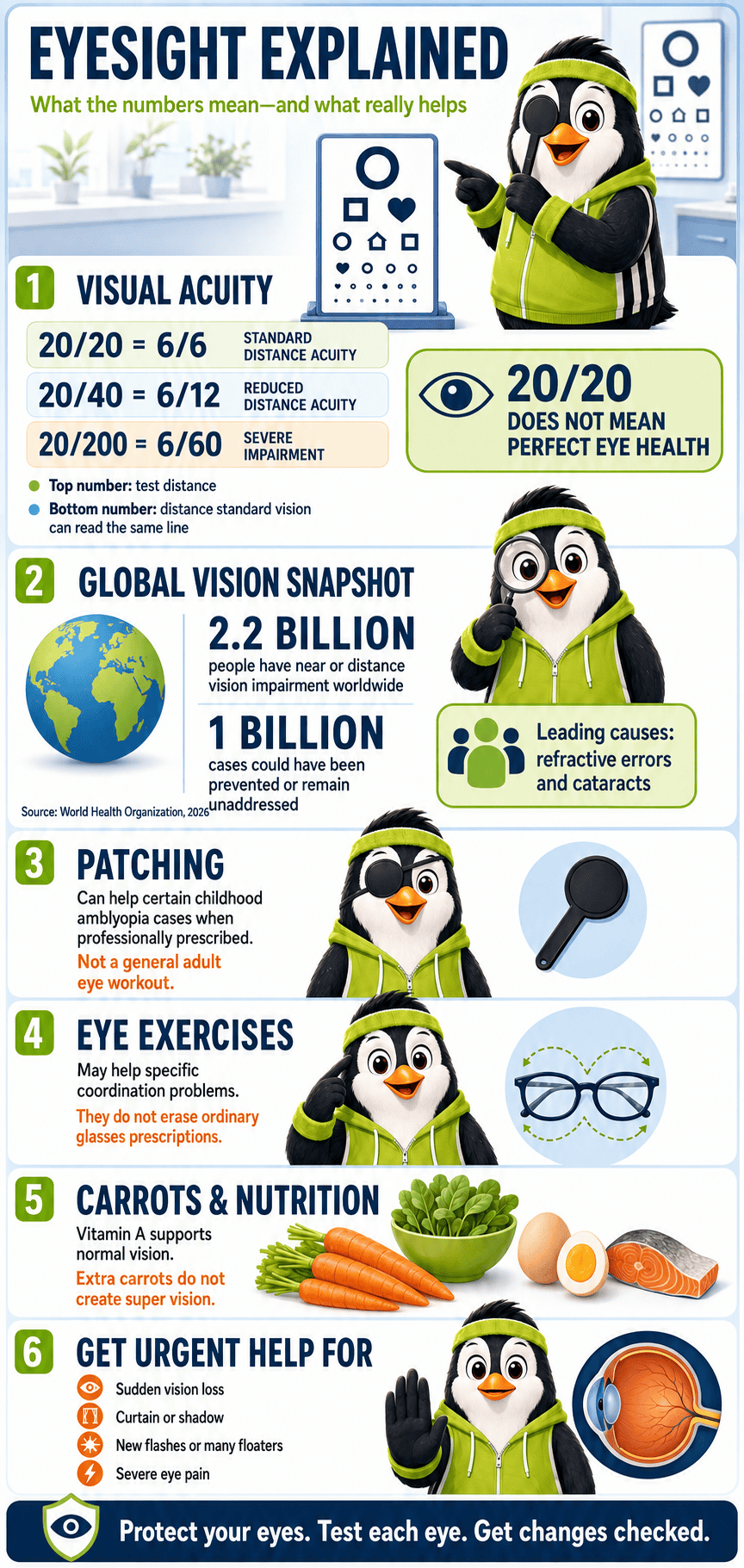
Visual acuity describes how clearly you can distinguish shapes and details at a standardized distance. In the 20/20 system, the first number represents the testing distance in feet, while the second represents the distance from which someone with standard visual acuity could read the same line.
The metric equivalent used in Canada and many other countries is based on metres:
- 20/20 is equivalent to 6/6: You see at 20 feet, or six metres, what a person with standard acuity sees at that distance.
- 20/40 is approximately 6/12: You must be 20 feet away to read what standard vision can read at 40 feet.
- 20/60 is approximately 6/18: You must move closer to see the same detail.
- 20/200 is approximately 6/60: At 20 feet, you see what standard vision can see from 200 feet away.
- 20/15 is better than the 20/20 reference level: You can distinguish at 20 feet detail that standard vision may need to approach to 15 feet to see.
These fractions measure distance clarity under test conditions. They do not fully describe peripheral vision, depth perception, colour vision, night vision, contrast sensitivity or eye health.
How Eyesight Is Measured
The familiar wall chart with progressively smaller letters is commonly called a Snellen chart. During the examination, one eye is covered while the other reads the smallest line it can identify accurately. Testing each eye separately is important because binocular vision—using both eyes together—can conceal a meaningful difference between them.
In Canada, distant visual acuity is commonly recorded as 6/6, 6/9, 6/12 or another metric fraction. If the smallest line someone can read is marked 6/12, that person sees at six metres what someone with standard acuity can see at 12 metres. A score of 6/60 means the person must be six metres from detail that standard vision could distinguish from 60 metres.
The result can be recorded as either uncorrected acuity, meaning without glasses or contact lenses, or corrected acuity, meaning while wearing appropriate lenses. This difference matters because someone may have poor uncorrected vision but reach 6/6 with glasses. Another person may remain below 6/6 even with the best available prescription, suggesting that something other than a simple refractive error may be limiting vision.
Near vision is tested differently, usually with smaller print held at a normal reading distance. Eye-care professionals may also evaluate refraction, pupil reactions, eye pressure, retinal health, eye movements, visual fields and how well the two eyes coordinate. A quick chart screening therefore cannot replace a comprehensive eye examination.
Why 20/20 Does Not Mean Perfect Vision
The expression “20/20 vision” has become shorthand for flawless eyesight, but visual acuity only measures the ability to resolve detail at a particular distance. A person can read the 20/20 line while still having reduced peripheral vision, poor contrast sensitivity, colour-vision deficiency or difficulty seeing in low light. Early glaucoma and some retinal conditions may exist before central acuity noticeably declines.
Depth perception is another separate ability. True stereoscopic depth perception depends on the brain combining the slightly different image received by each eye. Other cues—such as shadows, relative size, motion and perspective—also help the brain judge distance, which is why people with one functional eye can adapt surprisingly well.
Common focusing problems are known as refractive errors. Myopia causes distant objects to appear blurry, while hyperopia can make near work more difficult. Astigmatism results from an uneven curvature of the cornea or lens, and presbyopia is the age-related loss of near-focusing ability that commonly becomes noticeable in middle age. Glasses, contact lenses and certain surgical procedures can correct many refractive errors, but they do not necessarily treat diseases affecting the retina, optic nerve or other eye structures.
Why Having Two Functioning Eyes Matters
Each eye views the world from a slightly different position. The brain combines those images to create binocular vision, providing a wider field of view and more precise depth information. This is particularly helpful when catching an object, judging traffic distance, climbing, operating machinery or performing work that requires accurate hand-eye coordination.
When one eye sees much more clearly, the brain may rely more heavily on the better image. In some circumstances it may partially suppress, or ignore, information from the weaker eye. This is especially important during childhood, when the visual areas of the brain are still developing.
A person with useful vision in only one eye may lose some peripheral coverage and fine stereoscopic depth perception. The remaining eye does not literally become more powerful, but the person often becomes better at using other distance cues. Protecting the better-seeing eye with appropriate safety glasses becomes particularly important during construction, woodworking, sports, yard work and other activities with a risk of flying debris.
Why One Eye May Be Weaker Than the Other
A difference between the eyes can come from something as straightforward as unequal prescriptions. Anisometropia is the clinical term for a significant difference in refractive power between the two eyes. One eye may be more nearsighted, farsighted or astigmatic, causing the brain to favour the clearer image.
Other possibilities include amblyopia, strabismus, cataracts, corneal scarring, retinal disease, optic-nerve damage or an earlier eye injury. A new change in one eye is not something that should automatically be blamed on aging, fatigue or excessive screen use. The cause determines whether the appropriate treatment is glasses, monitoring, medication, surgery, childhood amblyopia treatment or another form of care.
Comparing the eyes independently can reveal problems that binocular vision has been concealing. A person might not notice gradual deterioration because the clearer eye continues producing a usable combined image. That is one reason regular examinations and occasionally checking each eye separately can be valuable.
Can Covering the Stronger Eye Improve the Weaker Eye?
Eye patching is a legitimate treatment, but only for particular conditions and usually during childhood. It is most commonly associated with amblyopia, sometimes called lazy eye. Amblyopia occurs when the developing brain does not learn to process a clear image from one eye, even though that eye may appear structurally normal.
In a child with amblyopia, an ophthalmologist may prescribe glasses followed by patching of the better-seeing eye. Temporarily covering the better eye forces the brain to use information from the weaker eye. Atropine drops or specialized binocular treatments may sometimes be used for a similar purpose, depending on the child and the cause of the amblyopia.
Treatment works best while the visual system is developing, although some children and younger teenagers can still benefit when treatment begins later. The number of patching hours matters and must be adjusted according to the child’s age, acuity and response. Excessive or incorrectly managed patching can create problems in the previously stronger eye, which is why follow-up examinations are part of proper treatment.
An adult should not begin covering the better eye in hopes of sharpening a weaker one. Patching cannot reshape the cornea, reverse retinal damage, remove a cataract or correct an inaccurate prescription. It also temporarily removes stereoscopic depth perception and reduces the usable visual field, making driving, stairs, power tools and machinery less safe.
The sensible first step is determining why the eye sees poorly. A patch is a prescribed neurological treatment for specific developmental conditions—not a general workout for any blurry eye.
Can You Train Your Eyes With Exercises?
Some aspects of visual coordination can be trained, but ordinary eye exercises do not generally improve refractive errors. Myopia often involves the physical length of the eyeball, astigmatism involves optical curvature, and presbyopia results from age-related changes in the focusing system. Repeatedly rolling the eyes, focusing on distant objects or following a pencil cannot ordinarily reverse those structural causes.
Exercises may help certain binocular-vision disorders. Convergence insufficiency, for example, makes it difficult for the eyes to turn inward and remain coordinated during close work. A trained optometrist, ophthalmologist or orthoptist may prescribe controlled convergence activities, office-based therapy or other treatment after confirming the diagnosis.
Eye-tracking and focusing exercises may also be used in carefully selected cases involving alignment, movement or rehabilitation. That does not mean a generic online routine can make healthy eyes “sharper.” The exercise needs to address a diagnosed functional problem rather than promise an across-the-board increase in acuity.
The popular 20-20-20 rule serves a different purpose. Looking approximately 20 feet away for 20 seconds after about 20 minutes of close screen work may help the eyes relax and can remind someone to blink more often. It may reduce temporary strain or dryness, but it does not permanently cure nearsightedness or eliminate a glasses prescription.
Which Eye-Care Professional Should You See?
The words optometrist, ophthalmologist and optician are sometimes used interchangeably, but these professionals have different training and responsibilities. Their exact scope of practice can vary by province or territory, particularly concerning medications and certain procedures.
- Optometrist: A primary eye-care professional who performs comprehensive examinations, measures prescriptions, prescribes glasses or contact lenses, and diagnoses or manages many eye conditions.
- Ophthalmologist: A medical doctor specializing in eye disease, medication, surgery and complex medical eye care.
- Optician: A regulated professional who prepares, fits and dispenses glasses and, depending on local licensing, contact lenses. An optician is not an eye doctor.
- Orthoptist: A specialist in eye alignment, eye movements and binocular-vision disorders such as strabismus and amblyopia.
- Low-vision specialist: A professional who helps people use remaining vision through magnification, lighting, adaptive equipment and rehabilitation strategies.
An optometrist is often the appropriate starting point for routine examinations, changing prescriptions or unexplained blurriness. An ophthalmologist may become involved when surgery, complex disease, retinal treatment or advanced medical assessment is required. Sudden or severe symptoms should be treated as urgent rather than postponed until the next routine examination.
Eyesight and Canadian Military Eligibility
Military visual standards exist because certain duties involve weapons, vehicles, aviation, navigation, low-light environments and rapid decisions where visual limitations could affect safety. However, it is inaccurate to say that everyone needs perfect uncorrected vision in both eyes to join the Canadian Armed Forces. The required standard depends partly on the occupation.
The CAF tests each eye separately and assigns a visual-acuity category from V1 through V5. Testing considers uncorrected acuity, corrected acuity and the amount of refractive error. Colour vision is assessed separately through categories such as CV1, CV2 and CV3.
Under the published visual-acuity table, V1 represents strong uncorrected vision, while some lower categories allow reduced uncorrected acuity if the applicant’s eyesight can be corrected adequately. Specific military occupations establish their own minimum medical categories. Aircrew, diving and specialized operational roles may have additional or stricter requirements.
This means a person who wears glasses, has unequal prescriptions or has one weaker eye should not assume automatic disqualification. At the same time, being able to function comfortably in everyday life does not guarantee eligibility for every trade. Applicants need an official assessment based on the current requirements for the occupation they are pursuing.
Are Carrots Really Good for Eyesight?
Carrots earned their eye-health reputation because they contain beta-carotene, an orange pigment that the body can convert into vitamin A. Vitamin A is required for normal retinal function, including the production of light-sensitive compounds used in low-light vision. A serious vitamin A deficiency can cause night blindness, dryness and eventually permanent eye damage.
That does not mean eating extra carrots will produce better-than-normal eyesight. Once someone receives adequate vitamin A, loading up on one food will not correct astigmatism, strengthen an adult amblyopic eye or repair an unhealthy optic nerve. Carrots support normal biology; they are not natural prescription lenses.
A varied diet provides a broader range of nutrients associated with normal eye function:
- Orange vegetables such as carrots, squash and sweet potatoes provide beta-carotene.
- Dark leafy vegetables contain lutein and zeaxanthin, carotenoids concentrated in the retina.
- Eggs provide several eye-related nutrients in a form that is easily included in ordinary meals.
- Salmon, sardines and other oily fish provide omega-3 fatty acids.
- Broccoli, peppers, fruit, nuts and seeds contribute antioxidants, minerals and healthy fats.
- Dairy products, eggs and certain fish provide preformed vitamin A.
High-dose supplements should not be treated as harmless insurance. Excess preformed vitamin A can cause toxicity, and certain high-dose formulations are intended only for people with specific diagnoses under professional guidance. A generally nutritious diet, not smoking, managing blood pressure and diabetes, wearing UV-protective sunglasses and using proper safety eyewear are more sensible foundations for long-term eye health.
Do Blind or Deaf People Develop Heightened Senses?
People who lose one sense do not automatically receive superhuman abilities in the others. What can occur is neuroplasticity, the brain’s ability to reorganize how it processes information. Someone who is blind may become highly skilled at interpreting subtle differences in sound, touch, airflow or echoes because those signals receive more attention and practice.
Similarly, some deaf people demonstrate stronger performance on particular visual tasks, especially peripheral attention or detecting movement outside the centre of vision. That does not necessarily mean they have better scores on a standard acuity chart. The advantage is usually task-specific and influenced by experience, age, language, training and when the sensory loss occurred.
This distinction matters because adaptation is impressive without needing to turn it into a myth. The eyes and ears may not become anatomically stronger, but the brain can become more efficient at using the information that remains available.
How to Protect Your Eyes in Everyday Life
Most practical eye care is less exciting than miracle exercises or superfoods. Wear appropriate protection around saws, grinders, chemicals, projectiles and yard equipment. Use sunglasses that block ultraviolet radiation, manage chronic conditions such as diabetes and high blood pressure, avoid smoking and follow the examination schedule recommended for your age and medical history.
Screen use can produce dryness, fatigue and temporary blur, particularly when people blink less and spend hours focusing at one distance. Reasonable breaks, proper lighting, a comfortable viewing distance and treating diagnosed dry eye can help. Persistent blur, headaches or double vision should be examined rather than continually blamed on screen time.
Seek prompt medical attention for warning signs such as:
- Sudden vision loss or a major new reduction in one eye
- A curtain, veil or shadow crossing the visual field
- New flashes of light or a sudden shower of floaters
- Severe eye pain, marked redness or light sensitivity
- A chemical splash or penetrating injury
- Sudden double vision
- New distortion, missing areas or rapidly worsening peripheral vision
These symptoms cannot be safely evaluated through an online eye chart. Some causes are time-sensitive, and delaying assessment may reduce the chance of preserving vision.
The Bottom Line on Eyesight
A 20/20 or 6/6 score is useful, but it is not a complete certificate of perfect eye health. Good vision also depends on visual fields, contrast, colour perception, depth, eye coordination and healthy structures extending from the cornea to the optic nerve and brain. Testing the eyes separately is important because one eye can conceal deterioration in the other during ordinary binocular viewing.
Carrots and other nutritious foods help supply the materials required for normal vision, but they cannot replace corrective lenses or medical treatment. Eye exercises can help selected coordination disorders, but they do not generally reshape the eye or cure common refractive errors. Patching the better eye can be valuable for prescribed childhood amblyopia treatment, but adults should not experiment with it as a home vision workout.
The most useful “eye training” is paying attention to changes, protecting the eyes during risky activities and getting the correct professional assessment when something seems different. Eyesight is too important to gamble on a myth when the real cause may be measurable, manageable or time-sensitive.
- American Association for Pediatric Ophthalmology and Strabismus: Amblyopia — Explains why amblyopia develops and how professionally supervised patching treatment works.
- Canadian Armed Forces Instructions for Testing Visual Acuity — Provides the official CAF testing procedure and V1-to-V5 visual-acuity standards.