
Muscle Soreness vs. Joint Pain After a Hard Week: How to Tell the Difference
You hit the gym over the weekend, helped someone move on Monday, spent Tuesday carrying boxes, gripping awkward furniture, hauling bags, climbing stairs, and generally being more active than usual. Then you wake up wondering why your forearms hurt, your wrists feel achy, your elbows feel stiff, your biceps are sore, and your legs feel like they lost an argument with a forklift.
This is where a lot of people start spiralling. Is it normal muscle soreness? Did you overdo it? Is it tendon pain? Is it arthritis? Should you stretch, rest, train through it, take supplements, or panic-buy a giant bottle of fish oil?
The honest answer is that soreness after a hard week is common, especially when your activity included unfamiliar lifting, gripping, carrying, twisting, or lowering heavy objects. But not every ache should be treated the same way. Learning the difference between ordinary muscle soreness, tendon irritation, and possible joint pain can help you recover smarter instead of either babying yourself unnecessarily or trying to “tough it out” through something that deserves attention.
Quick Answer: Muscle Soreness vs. Joint Pain
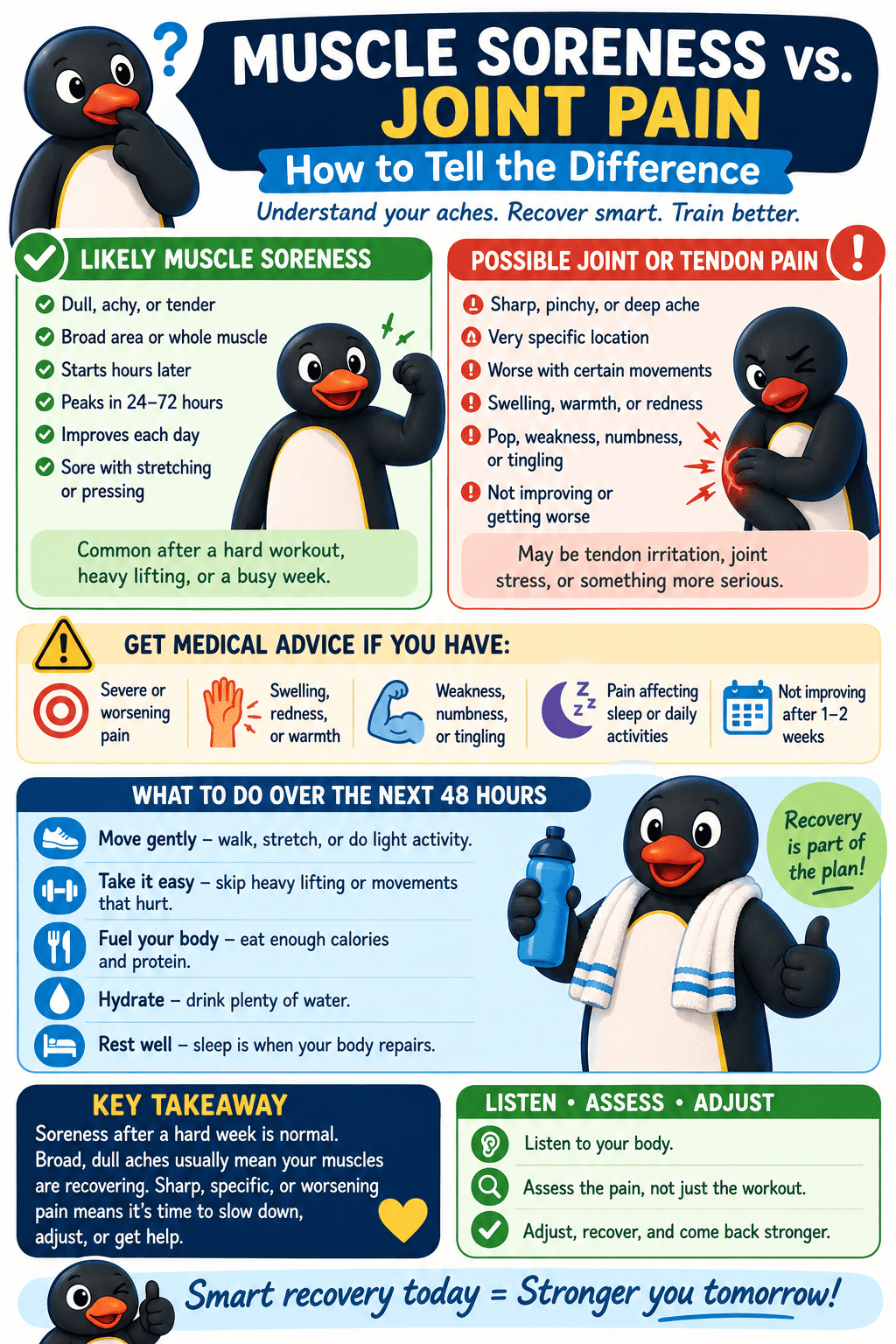
Normal muscle soreness usually feels broad, dull, tender, and connected to a muscle you clearly used. It often becomes more noticeable several hours after a hard or unfamiliar activity, can peak one to three days later, and gradually improves as you recover.
Possible tendon or joint pain is more likely to feel specific and localized. It may be directly around a wrist, elbow, knee, shoulder, or ankle, and it can become sharper, pinchy, stiff, weak, or more painful during a particular motion such as gripping, twisting, pushing, pulling, or bearing weight.
A useful rule is this: muscle soreness usually says, “I worked hard.” Tendon or joint pain often says, “This particular movement does not feel right.”
That is not a diagnosis. It is simply a practical way to notice patterns before deciding whether you need a lighter day, a few days of recovery, a physiotherapist, or a medical assessment.
Why a Hard Week Can Leave Your Whole Body Feeling Beat Up
People often think of exercise as something that only happens in a gym. That is not how your body sees it.
A full-body workout, a weekend of lifting, moving furniture, carrying boxes, working with tools, helping friends relocate, climbing stairs, pulling heavy doors, and gripping awkward objects all create physical stress. Your body does not care whether the load came from dumbbells, a couch, a toolbox, or a bag of concrete.
Hard physical work can create soreness in several places at once because your body is constantly stabilizing itself. Your forearms work while you grip. Your wrists work while you hold objects steady. Your elbows and biceps help bend, carry, pull, and lift. Your legs absorb the work of walking, squatting, climbing, and bracing. Even when something does not feel “heavy” for one second, holding or carrying it for several minutes can be a serious challenge.
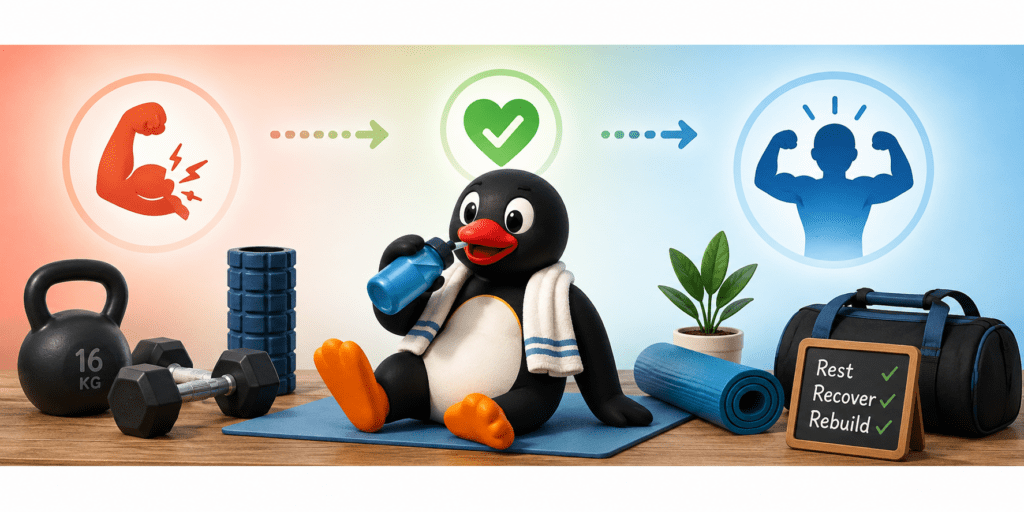
Muscle pain after exercise or physical labour is often related to overuse, tension, or an activity that pushed a muscle harder than it is used to working. That does not automatically mean injury. It means recovery needs to be part of the plan.
Think in Three Buckets: Muscle, Tendon, or Joint
The phrase “joint pain” gets used for almost everything around a joint. That can make it confusing.
You may have soreness in a muscle near a joint. You may have irritation in a tendon that connects a muscle to bone. Or you may have pain coming from the joint itself. These can overlap, which is why a sore elbow or wrist can feel hard to figure out.
1. Muscle soreness
Muscle soreness is often felt in the thicker, softer part of a muscle. Think biceps, triceps, quads, hamstrings, calves, glutes, chest, shoulders, or forearms.
It usually feels like a dull ache, stiffness, tenderness, or heaviness. Pressing on the muscle may feel uncomfortable. Stretching the muscle or contracting it may also make it feel sore.
A classic example is doing more squats than usual and feeling your quads complain when you sit down on the toilet the next day. Another is spending hours carrying boxes and noticing that your forearms and biceps ache when you grab a mug or bend your arm.
2. Tendon irritation
Tendons connect muscles to bones. They are tough connective tissues, but they can become irritated when they are asked to do too much gripping, twisting, lifting, throwing, pushing, or repetitive work.
Tendon pain often feels close to a joint rather than in the middle of a muscle. For example, soreness around the outside of the elbow after lots of gripping may involve the forearm tendons that attach near the elbow. Repetitive and vigorous use of the forearm and wrist can contribute to this kind of elbow pain, even in people who have never touched a tennis racket.
Tendon irritation may feel stiff when you first start moving, more noticeable during a particular motion, or sore after the activity is over. It can also be tender in one very specific spot.
3. Joint pain
Joint pain is usually felt deeper in the area where two bones meet. It may feel like aching inside the elbow, knee, shoulder, wrist, ankle, or hip rather than in the surrounding muscle.
Some joint symptoms can include swelling, warmth, reduced range of motion, stiffness after resting, popping, catching, locking, instability, or pain during weight-bearing. Wrist problems, for example, can involve joints, tendons, ligaments, nerves, or bones, which is why wrist pain should not automatically be called “arthritis.”
What Normal Muscle Soreness Often Feels Like
Delayed onset muscle soreness, often called DOMS, is the soreness that shows up after a hard, unfamiliar, or more intense-than-usual activity. It is especially common after exercises that involve lowering weight under control, such as the lowering part of squats, push-ups, pull-ups, lunges, rows, or carrying things downstairs.
Muscle soreness often follows a predictable pattern. It may not feel too bad right after the activity, then start showing up later that day or the next morning. It commonly peaks between 24 and 72 hours after the activity and then gradually fades.
Here are some signs that your pain is more likely ordinary muscle soreness:
- The soreness is in a muscle you clearly used.
- It feels broad or spread across an area instead of sharply pinpointed.
- Both sides of your body may feel similarly sore after a balanced workout.
- The muscle feels tender when pressed.
- It is worse when you stretch or flex that muscle.
- You can still move normally, even if you feel stiff.
- It gradually improves day by day.
Normal soreness can be annoying, but it should not feel like your body is breaking down. You may move slower, feel stiff, or feel weaker for a couple of days, but the overall direction should be improvement.
Clues It May Be More Than Normal Soreness
A hard week can create normal soreness and still irritate a tendon or joint at the same time. This is why paying attention to the exact location and trigger matters.
Be more cautious when pain is very specific, sharp, deep, or linked to one particular movement. For example, if your forearm is generally sore after carrying boxes, that may be ordinary muscle soreness. But if twisting a doorknob creates a sharp pain on one side of your wrist, that deserves more respect.
Potential signs of tendon or joint irritation include:
- Pain directly on the outside or inside of the elbow.
- Pain that increases when gripping, twisting, carrying, or opening jars.
- A wrist that hurts more when bent in a specific direction.
- Swelling, heat, redness, or visible bruising.
- A popping sensation at the moment pain began.
- Weak grip strength that feels unusual for you.
- Pain that gets worse every time you train or work.
- Pain that affects sleep or normal daily tasks.
- Numbness, tingling, or burning into the hand or fingers.
Tendon problems can cause pain that worsens with movement, stiffness, difficulty moving the nearby joint, and sometimes swelling or warmth. That does not mean every stiff elbow is tendonitis, but it does mean repeated gripping and twisting deserve attention instead of being ignored for weeks.
Does Joint Pain Mean You Have Arthritis?
Not necessarily. This is an important point.
Arthritis is a broad term covering many different conditions. It is not the automatic explanation for every ache, creak, pop, or stiff morning. A very active week with a clear cause—such as lifting, moving, carrying, or returning to the gym after time away—can absolutely make your muscles, tendons, and joints feel rough for a few days.
Still, it is smart to notice patterns that do not fit ordinary recovery. Osteoarthritis commonly develops slowly over months or years and may involve joint pain, reduced range of motion, possible swelling, and stiffness after inactivity. Inflammatory arthritis can involve multiple joints, warmth, redness, swelling, fatigue, and morning stiffness that lasts longer than 30 minutes.
That does not mean you should self-diagnose based on a checklist. It means that if symptoms are recurring, spreading to multiple joints, lasting for weeks, or showing up without a clear training or activity cause, it is worth discussing them with a healthcare professional.
Being 36 does not mean you are “too young” to take symptoms seriously. It also does not mean every sore elbow means you are falling apart. The goal is to be observant without becoming dramatic.
A Simple Five-Minute Self-Check
Before you decide whether to train hard again, take a minute to assess the pattern.
Ask yourself:
- Where exactly is the pain?
Is it in the middle of a muscle, near a tendon, or deep inside a joint? - What movement triggers it?
Does it hurt when you flex a muscle, grip something, twist your wrist, squat, walk, or simply sit still? - Is it improving each day?
Ordinary soreness should slowly trend in the right direction. - Is there swelling, warmth, redness, bruising, numbness, or weakness?
Those are more concerning than regular stiffness. - Can you do normal daily tasks?
If opening a bottle, carrying groceries, walking upstairs, sleeping, or getting dressed is becoming difficult, do not brush it off.
You do not need to poke, stretch, or aggressively test the painful area over and over. That often just annoys it more. The goal is to gather useful information, not become your own full-time physiotherapist.
What to Do Over the Next 48 Hours
If your discomfort feels like normal muscle soreness, recovery does not need to mean lying completely still.
Light movement can help you feel less stiff. Easy walking, gentle mobility work, relaxed cycling, light stretching, and normal daily movement are often more useful than spending all day on the couch. At the same time, there is no prize for crushing another heavy workout when your body is clearly asking for a break.
A sensible recovery plan may include:
- Taking one or two lighter training days.
- Walking or doing gentle movement instead of hard cardio.
- Eating enough overall food, especially protein and carbohydrates.
- Drinking enough water throughout the day.
- Getting serious about sleep for a few nights.
- Avoiding max-effort lifting while your form is compromised.
- Training a different body part only if it does not aggravate the painful area.
- Using ice or heat for comfort if it helps you personally.
For a sore wrist, elbow, or tendon area, temporarily avoid the exact motions that make it worse. That may mean less heavy gripping, fewer pulling exercises, lighter dumbbells, neutral wrist positions, or skipping the movement that creates sharp pain. NHS guidance for tendon pain specifically recommends avoiding heavy lifting, strong gripping, and twisting actions that worsen symptoms while the area settles down.
The mistake is not taking a few easier days. The mistake is turning every minor ache into a full shutdown—or pretending a sharp, worsening pain is “just soreness” because you do not want to lose momentum.
When to Get Medical Advice
Most post-workout soreness improves with time. But there are situations where getting checked is the smart move.
Book an appointment with a doctor, physiotherapist, or other qualified healthcare provider if pain is getting worse, keeps returning, affects your sleep, stops you from doing normal activities, or does not improve after around two weeks of basic self-care.
Seek urgent help after an injury if you have severe pain, cannot bear weight, cannot use the limb normally, notice obvious deformity, or have tingling or loss of feeling around the area. A hot, swollen joint along with fever, chills, or feeling generally unwell also needs prompt medical attention.
That is not being weak. That is protecting your ability to train, work, build, carry, move, and live normally over the long term.
The Bottom Line
A hard week can leave you sore from head to toe, especially when gym workouts and real-life labour pile up together. Broad tenderness in muscles you clearly used, stiffness that peaks a day or two later, and gradual improvement usually point toward ordinary post-exercise soreness.
Pain that is sharp, very localized, swollen, hot, weak, numb, worsening, or connected to one specific motion deserves more caution. It may be a tendon issue, joint irritation, or something else that should not be trained through blindly.
The best fitness mindset is not “never get sore.” It is learning to listen to the difference between normal recovery discomfort and a signal that your body needs a smarter response.
Related External Links
- Arthritis Society Canada: Signs of Arthritis — Learn about common arthritis warning signs and when persistent joint symptoms deserve medical attention.
- AAOS: Tennis Elbow (Lateral Epicondylitis) — Understand how repetitive gripping and forearm use can contribute to pain around the outside of the elbow.
Just a heads up to all those youngins: getting older means longer recovery time and if you over do it or are just getting back into the swing of being active it’ll take you a while to get going once you get out of the bed in the morning. Like hours some days. The key is to slowly warm your body back up and those aches and pains will improve as the day goes along…hopefully